The Storks of Böbs

The Storks of Böbs
A Very Fine Pair

Goose Consommé with goose liver Spätzle

For the consommé I use the freeze/thaw method that I first read about in Heston Blumenthal "The fat Duck Cookbook" and saw on one of his TV programmes. It has also been discussed in great detail on various websites, I have also used it and published this on this blog previously when I made a Game consommé with hare liver Spätzle.

Ingredients:

1 goose carcass (or bits and pieces, like neck, crops, wings)
2 dsp. of Goose fat
2 carrots
1 piece of celeriac
1 leek white only
1 onion
2 cloves of garlic

2 bay leaves
5 juniper berries
10 allspice berries
½ tsp of mace
1 sprig of rosemary
2 tsp of vegetable stock powder
1 tsp of dried thyme
1 tsp of cumin  seeds
3 ltr water

2 table spoons of port
1 tsp of fresh picked thyme leaves

Peel and chop the root vegetables, cut the onion into quarters, and put into a roasting tin, put the goose pieces etc. on top pour over a couple of spoons of goose fat over the top, grind over plenty of black pepper and dust with sea salt, put into a hot oven and roast for 20 minutes.

In the meantime put the spices, herbs etc. into the pressure cooker pour over the water and bring to the boil. 

When the goose bones and vegetables are suitably browned, pour into the pressure cooker, bring to a rolling boil and skim off any scum and fat that rises and , lid on and bring up to the pressure (highest).
Pour all of the roasted bones and veg

Cook for 30 minutes and then allow to cool. Remove the lid and pour all though a fine sieve into a clean container. Discard the solid matter and allow the liquid to cool.  Put the cooled stock into the deep freeze. When the stock is solid (overnight), remove from the freezer, scrape off any fat that is solid on top and filter.


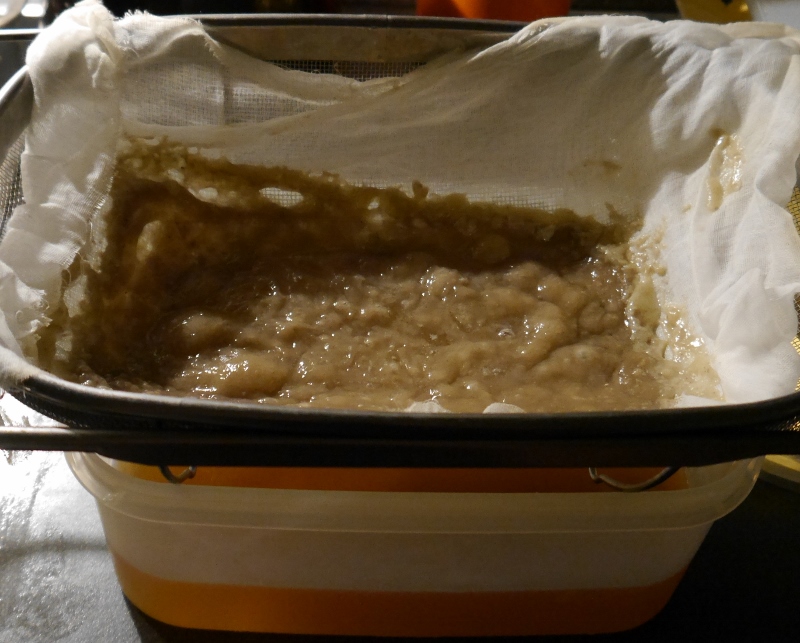
 I do this by lining a long sieve with a double layer of muslin, I filter into the same container (washed) that I had frozen the stock in. Allow the frozen block to drip, drip, drip into the container, depending on the quantity and temperature it will take anything between 8 and 18 hours ,overnight is good  for two reasons, 1 it will be ready for the next morning and 2 you will not be likely to fiddle with it. Do not be tempted to prod and poke it as this will loosen up the residue/sludge and it could cloud the consommé. I stop filtering when it reaches the position of 5mm thick of frozen. Remove the whole filter complete with contents, how you dispose of this is your problem, but washing the muslin straight away in very hot water is a must as otherwise it sticks like glue.
Allow to thaw overnight
Discard the sludge
The consommé is now almost ready; you just need to add the port and the fresh thyme leaves, I tested it was clear by heating a little and testing it, wink, wink nudge, nudge, well you can't have your guests drinking any old muck.


I was making a goose liver spätzle consommé so next was the making of the Spätzle.

Ingredients:
75g goose liver (or as in this case the liver from the goose which just happened to weigh 75g)
1 large egg
Scraping of nutmeg
100g plain flour
½ tsp of salt
A small pinch of white pepper
1 tsp of fresh thyme leaves
1 table spoon of mineral water (I use an egg cup that is spot on a table spoon)

Put the flour, nutmeg and salt into a mixing bowl, add the egg and mix with a wooden spoon, when the egg is incorporated into the flour and salt (it will look a bit lumpy but that doesn't matter) now slowly add the water a little at a time (it is little so that isn't too difficult)


Purée the liver (most recipes say put it through a mincer, rubbish use a magic wand, quicker, easier to clean).


Add this to the batter and beat until bubbles rise and hold their form,stir in the thyme and pepper. Cover and allow to stand for at least 30 mins.


When ready to make your spätzle (they can be made well in advance), put a pan of  stock (or salted water, I used chicken stock) on to a rolling boil and have a pan with cold water and a sieve ready.


Have your spätzle board ready, this should be wet, put a good dollop (about 10cm dia) onto the board and with a long knife (or a palate knife) smooth the batter towards the rear of the board, now in quick forward movements scrape a thin roll of the batter into the stock (some will be thicker than others it matters not one jot). 


When all of the batter on the board is used, wait until the spätzle rise to the surface scoop out with a slotted spoon and place in the cold water to stop the cooking (too much cooking and they are likely to go a bit rubbery). Remove from the water and drain; these are now ready to add to the consommé. Repeat until all of your batter is used up.

You can at this point reduce the consommé even more, by boiling vigorously, but I found it was sufficient goosy.

Place the spätzle back into the pan of stock that they had been cooked in and warm through, bring your consommé to just below boiling and place a tablespoonful of spätzle into each soup plate, and ladle over the hot consommé, serve immediately with some crusty bread or baguette.

Bit wiggly but the table wouldn't hold still 


Red Deer Fillet Strogonov

Red Deer Stroganov

On one of the cookery boards, of which I am a member, there had been a discussion about the ins and outs of making a Beef Strogonov, I decided that making it with red deer fillet would be another step up in opulence, I thought that as the one served in a lot of top class restaurants bears no resemblance to the original Russian dish, then I was quite at liberty to adjust mine. I tried to keep as near as possible to my dear friend Ian's recipe, but did tweak it a little. 

The original recipe published in Elena Molokhovets Russian cook book back in 1871 contained only cubes of beef sautéed and served in a sauce made from mustard and bullion  finished with a small amount of soured cream, it contained neither mushrooms nor onions.

So here is my version.
Ingredients.
  
First get yourself a deer preferably red as it will have a decent sized fillet, well 2 actually. This one was a good 750g after preparation. I removed the silver skin and cut off the fillet head (the thick part that sits at the top side of the long fillet).

As I said above I used my friend’s recipe and he had borrowed it from an original recipe. I did make a few changes, as the original used beef fillet (well what else would you expect in a beef stroganov?).
The making of the stroganov is actually very quick, the longest part is preparing the fillet and sautéing the onions and mushrooms.


750g of trimmed red deer fillet (from the thin end) sliced into rounds approx. 6-10mm thick then cut into lengths. 


1½ tsp. of mustard powder
1½ tsp. caster sugar
1 pinch of Marigold stock powder
200g of brown cap mushrooms
150g of ceps
150 g of chanterelles
4 medium onions (peeled)
450ml of crème fraiche
Salt and pepper to taste
200ml of vegetable oil

Make the mustard powder, sugar and Marigold powder to a paste with a little warm water and allow it to stand for about 15 minutes prior to use.
Slice the onions very thinly, clean the mushrooms, these were fresh so still had some soil, leaves and grass, so use a stiff small brush, then cut out any soft and wormy parts. Slice them to thinnish pieces. Pour half of the oil into a hot heavy bottomed frying pan add the onions and the mushrooms, reduce the heat and sauté (cover and reduce the heat to very low) for 20 minutes about ½ way through add the crème fraiche to the onions and mushrooms, add the mustard paste and stir in, cover for a further 10 minutes.


In a second frying pan heat the remainder of the of the oil, smoking hot, add half the fillets strips, quickly  brown all around, remove and place in the onion, mushroom melange, repeat with the rest of the fillet strips again adding to the sauce. Stir in and adjust seasoning, this needed just a couple of turns of cracked black pepper. 


Serve at once in a pre-heated terrine; we ate it with savoy cabbage and gnocchi.

Very, very tasty and well worth the small amount of effort, a perfect dinner party dish.

A Roe Buck was invited to dinner


It is that time of the year again; autumn and game is on the menu.
The Autumn Table

The venue was out in Rural Kiel and our dear friend Carolyn was hosting and also cooking the main, it was to be saddle of young Roe Buck.

But first a few glasses of sparkling Sekt, then Kalle went into the kitchen to make his starters, it was a poached pear, blue cheese, hazelnut salad, wonderful and light, very tasty a very nice start to the evening.
Kalle preparing the starter

The tasty starter on the table
The wine was a Chardonnay Steinacker

Next was my smoked fish soup.

Ingredients:
Fish stock (I had some already made and frozen, but a jar or a cube will do)
200g of undyed smoked cod
200g of undyed smoked haddock
100g piece of smoked eel
100g smoked trout
100g of Stemmellachs (Hot smoked salmon originally recipe from Pommerania)
15 smoked king prawns
2 carrots
1 wedge of celeriac
1 leek white and light green only (cut in two)
2 cloves
2 pimento berries (all spice)
1 tsp of marigold powder (veg stock)
400ml fish stock (own, jar or made from stock cube)
2ltr of water
1 egg white beaten

While in the UK earlier in the week I had been to the fish counter and bought some smoked (not dyed) haddock and smoked cod (I had planned ahead), on Friday I visited Gosch (an excellent fish purveyor in CITTI) of Sylt and had bought some smoked eel, smoked trout and a piece of Stremmel lachs (hot smoked Baltic salmon).
I first skinned and boned the fish, this went into a pot with some fish stock that I had in the freezer, a diced onion, a grated carrot, a piece of celeriac finely diced, white of a leek also finely diced, 2 cloves, 2 all spice berries, a bouquet garni sachet, a teaspoon of marigold stock powder, a pinch of kukurma (for colour) poured in 2 liters of cold water brought to the boil, skimmed and lowered the heat for 20 minutes.
Add the haddock and cod and poach for a few minutes until the fish is still translucent but just starting to flake. Remove from the liquid and set aside.
I then strained the liquid and clarified with an egg white filter. (Whip the white of an egg until quite fluffy (but not too firm) and put this into the liquid, bring to the boil and skim the resulting scum from the top with a slotted spoon.
The broth should be a clear golden yellow, tasting smoky and defiantly fishy.
This was the base of the smoked fish soup.

I next diced very, very fine (Brunoised) a carrot, a small piece of celeriac (a slice about 1 cm thick) a 3 cm piece of leek (white only) and a shallot. poached this in the stock.

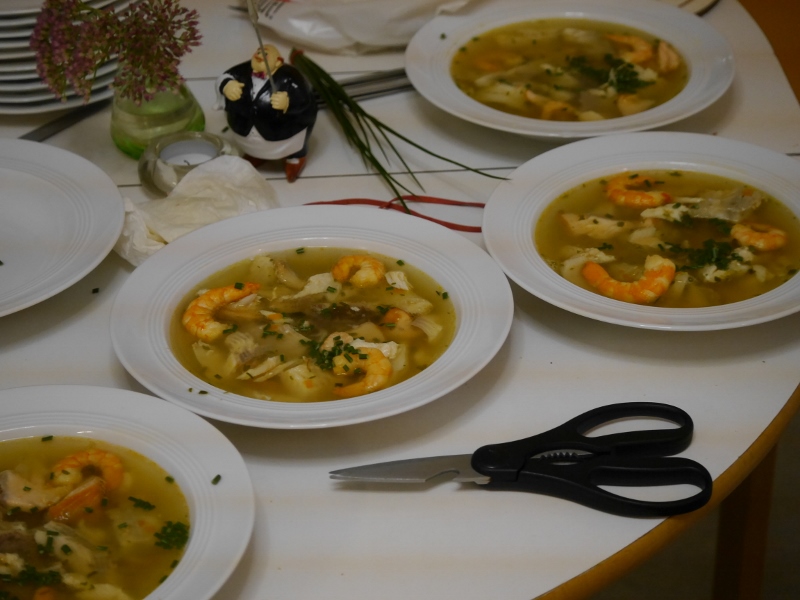
To serve break up the fish into mouth sized pieces (the eel will be soft and may break up into even smaller pieces, it matters not), place in the middle of a soup plate, place 3 of the smoked prawns on each plate, add a teaspoon of tomato petals.  

Bring the broth almost to the boil and ladle over the fish in the plates, snip some chives over and serve immediately.

I served olive rolls along with salty Breton butter and home made herb butter.


Wine was a dry Rotling from the Nahr.


Next along trotted the Roebuck Baden-Baden with cranberry filled poached pears, cepes, Brussel sprouts, red cabbage and spätzle.

As hostess this was Carolyn’s shout, she had bought a whole saddle of young Roebuck, this had been prepared by her local game purveyor.
Preheat the oven up to its maximum (250°-300°)
Melt 40-50g of butter in a small pan.
The saddle is washed and dried, and rubbed with a dry game spice marinade consisting of:
½ tsp Juniper berries
½ tsp allspice berries (pimento)
½ tsp black pepper corns
1 tsp of course salt

Crush all together in a mortar (or grind in an electric grinder).
Place the saddle on a rack in a large roasting pan add a good 2-3mm of red wine to the pan and pour over the saddle the melted butter and put into the hot oven. 

Roast at the high heat for 15-18 minutes (depending on the degree of redness of the meat required), now switch off the oven and allow the saddle to continue cooking for a further 30 minutes.
A perfectly roasted saddle of Roebuck (medium rare)
Vegetables were Martins Job, so in the meantime he washed and cook the Brussels sprouts, heated through the spiced red cabbage and set the salted water for the spätzle to boil, added the spätzle to the water and cook at a rolling boil for 8 minutes (or as directed on the packet) You can of course make your own, if you have the inclination.
Martin adding the nutmeg to his vegetables

Rear spiced cabbage, right spätzle, front game sauce, left Brussels sprouts
Remove the saddle from the oven, remove the filets (top and bottom) from the bones. 

Cut into nice size thick pieces (not fiddly slices).

In between make the sauce, pour the contents of the roasting pan into a sauce pan, add 400 ml of game stock, bring to the boil and add the puréed cranberries and add the cold Beurre Manié ( mixture of 50% butter mixed with 50% flour) in knobs whisking all the time until the sauce thickens.

Pour some over the meat and serve the rest in a sauce boat
Roe, filled pears and sprouts
We also had the cepes roasted alongside the meat and added to the sauce.  

An excellent main course, the meat was succulent and everything passed well together.


Caroline served a very nice 1999 –Bairadda wine as an accompaniment an excellent choice.


To finish the meal Linda had made a Raymond Blanc’s recipe “Poached Autumn Fruits in a spiced wine”

This consisted of:
4 quinces (peeled, cored and quartered)
4 Holstein Cox apples (peeled, cored and quartered)
4 ripe Conference pears (peeled, cored and quartered)
10 plump prunes
A couple of handfuls of blackberries (I had picked these a couple of weeks ago and frozen)
First make your poaching liquor.
Ingredients
800ml of red wine (cabinet Sauvignon in this case)
2 vanilla pods split
2 cinnamon sticks (each about 5cm long)
2 cloves
2 Bay leaves
100g of castor sugar
½ tsp of fresh ground black pepper
2 thick slices of lemon
2 thick slices of oranges.

Method:
Pour the wine into a large pan, bring to the boil and add the rest of the poaching ingredients
Reduce the heat to a gentle simmer and add the quince quarters, poach for 25 minutes, add the apple after 10 minutes and after a further 5 minutes the pears. Remove from the heat add the blackberries  and allow to cool then add the prunes. Allow to stand overnight so that the fruit can absorb the poaching liquor.

Linda had made some caramel croutons  and almonds to decorate and add a bit of a crunch to the finished dish.

Dice into cubes about 1cm sq. some stale bread and sprinkle with icing sugar allowing to caramelise in a frying pan, remove and allow to cool, add the almonds and sprinkle with icing sugar and also caramelise.

 When ready to serve arrange on to deep soup dishes, a piece of quince, apple and pear on each and spoon over the blackberries and prunes with plenty of jus. Sprinkle over the crunchy croutons and almonds.


A very pleasant relaxing evening, with good food, fantastic wines and wonderful company.